
 English

Development Context of Flocculants
Coagulants are a broad category of substances widely used in water treatment. Their primary function is to aggregate tiny suspended particles—too small to settle naturally—into visible flocs, which can then be separated through sedimentation or filtration.
This family has many members, each with their own expertise. To help you quickly establish a clear knowledge framework, you can start by understanding it from the following dimensions.
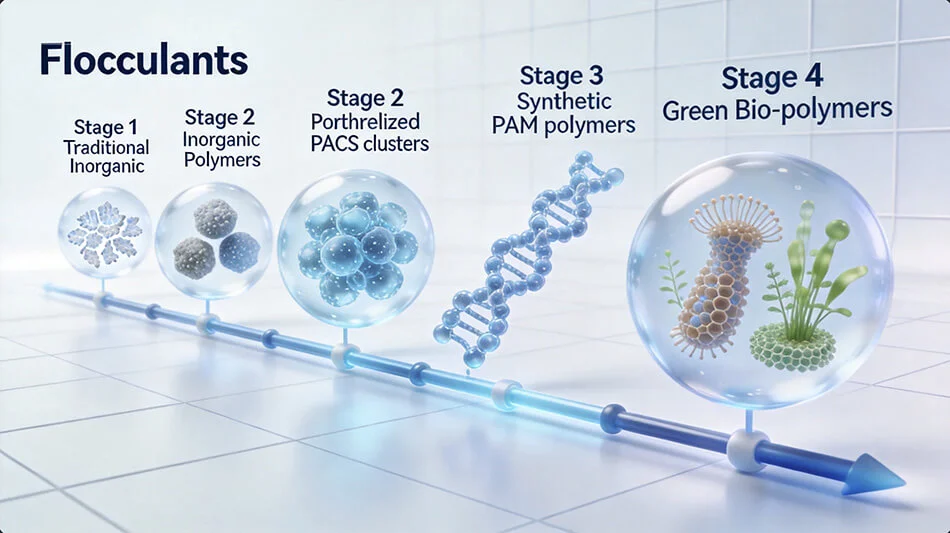
🧪 The Three Major Categories of Coagulants and Their Representative Products
Based on chemical composition and source, flocculants are primarily classified into three categories: inorganic, organic, and microbial, each with distinct characteristics and application scenarios.
|
Type |
Core representative products |
Main Features |
Precautions |
|
Inorganic flocculant |
Polyaluminum chloride (PAC), polyferric sulfate (PFS), aluminum sulfate, ferric chloride |
Widely used and cost-effective, PAC is a standout product with a broad pH range (5–9), large flocs, and rapid settling. |
Traditional low-molecular-weight aluminum and iron salts (such as aluminum sulfate and ferric chloride) are relatively less effective and sensitive to pH and temperature. Iron salts are corrosive, and excessive use of aluminum salts may pose health and ecological concerns. |
|
Organic flocculant |
Polyacrylamide (PAM) (non-ionic/anionic/cationic type) |
Highly effective at very low dosages. Through the "adsorption bridging" action of long molecular chains, it rapidly forms large and dense flocs. |
Expensive (8–10 times the cost of PAC); residual monomer (acrylamide) is toxic, limiting its application in scenarios such as drinking water treatment; dissolution requires careful handling and thorough mixing, otherwise it tends to clump and lose effectiveness. |
|
Microbial flocculants |
A natural polymer produced by specific microorganisms such as Rhodopseudomonas palustris |
It has prominent environmental benefits, causes no secondary pollution, and is considered the future development direction. |
Research and application are still in development, with cost and technological maturity being limiting factors for widespread adoption. |
Here is a concept that is often confusing: coagulant aids. They themselves have weak flocculation effects, but can enhance the performance of coagulants. For example, when the alkalinity of raw water is insufficient, adding lime helps create better conditions for flocculation reactions.
🛠️ Key Points and Common "Traps" in Use
Choosing a product is just the beginning; using the right methods is what makes things twice as effective. The following steps are where problems most often occur:
pH control (the critical factor for inorganic coagulants): Inorganic coagulants, especially aluminum and iron salts, are highly sensitive to pH. Taking aluminum salts as an example, they require a specific pH range—typically 6.5 to 7.5—to hydrolyze and form effective colloids, achieving optimal coagulation performance. An improper pH may result in reduced effectiveness or, in severe cases, complete failure.
Dissolution and dosing (challenges in handling organic coagulants): Organic high-molecular coagulants such as PAM cannot be added directly. They must first be diluted with clean water to form a weak solution (e.g., 0.1% concentration) before use. During operation, solid particles should be slowly and evenly sprinkled into stirred water. Avoid adding too much at once, as this may lead to insoluble "fish eyes" or flocs, which not only waste the chemical but could also clog pipelines.
Dosage and sequence (the details that determine success or failure):
Dosage: More is not always better. Excessive dosage may cause the colloids to "re-stabilize," thereby reducing flocculation efficiency.
Sequence: When inorganic coagulants are used in combination with organic coagulants (PAM), the inorganic coagulant is typically added first to destabilize particles, followed by the organic coagulant to enhance bridging and increase floc size. Reversing this order may result in poor performance.
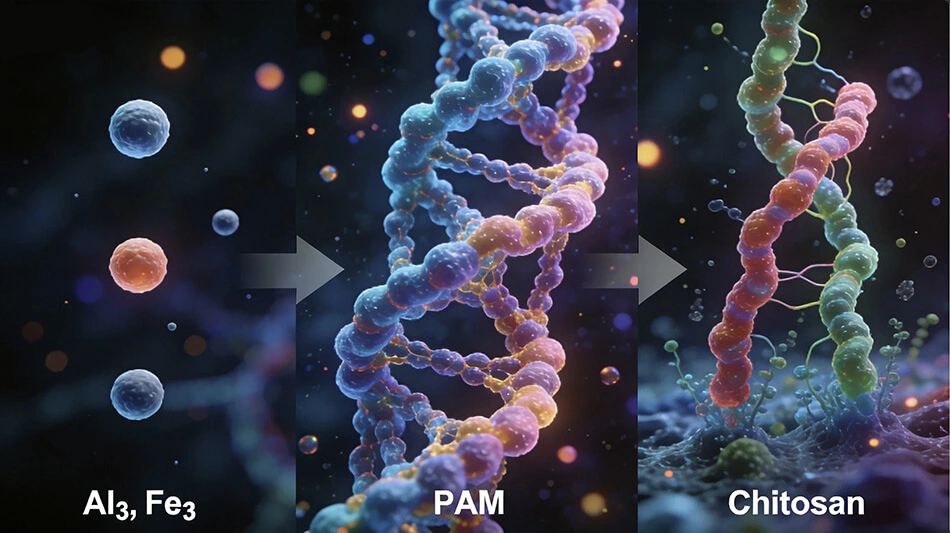
💎 Development Trajectory and Decision-Making Approach
From early alum and aluminum sulfate to more effective polyaluminum chloride (PAC), and then to the more economical polyacrylamide (PAM), the development of flocculants has consistently revolved around three goals: greater efficiency, lower cost, and improved safety. In practice, selection involves balancing these factors—cost, effectiveness, and safety. For instance, in industrial wastewater treatment where both performance and cost are critical, a combination of PAC and PAM may be chosen; whereas in drinking water treatment, where safety is paramount, the residual toxicity risks associated with PAM would be carefully evaluated.
If you could tell me the specific water quality conditions you're dealing with (such as what type of wastewater it is or what your treatment goals are), I can help analyze which product category might be more suitable as a starting point.