
 English

Defoamer – Characteristics, Differences, Advantages, and Applications
1. Product Overview
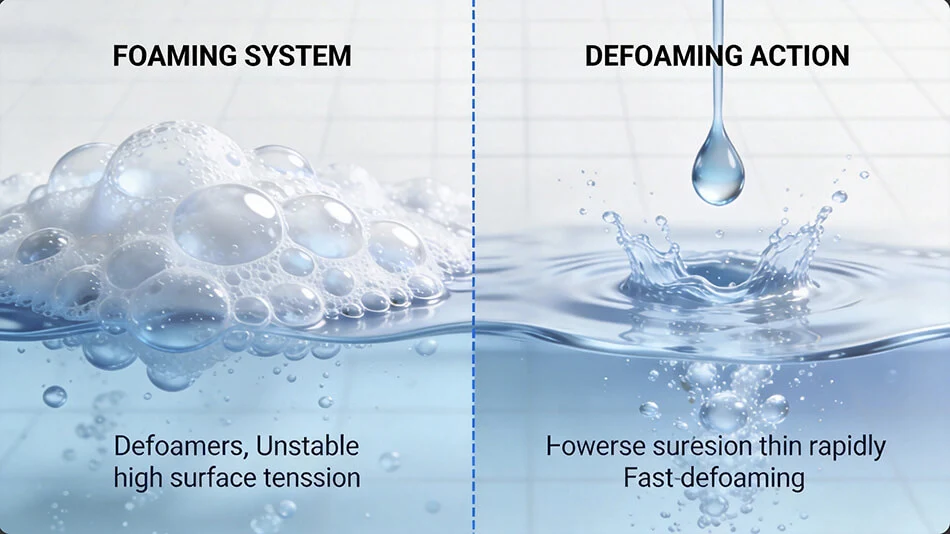
Defoamers are industrial additives that exert chemical and interfacial chemical effects to eliminate foam, widely used to remove harmful bubbles generated during production processes. In numerous industrial fields such as fermentation, water treatment, coatings, papermaking, and food processing, foam can lead to reduced equipment utilization, hindered gas-liquid mass transfer, and decreased product quality. Therefore, the proper selection of defoamers is crucial for ensuring stable and efficient process operation.
II. Main Categories and Characteristics
Defoamers are primarily classified into the following four categories based on their chemical composition:
1. Polyether-based defoamer
Primarily composed of polyoxypropylene and polyoxyethylene glycol ethers, it is currently the mainstream product in industrial applications, accounting for over 75% of the market share in the fermentation industry. Its key features include:
Strong defoaming ability with some foam suppression capacity, making it the most widely used type of defoamer currently.
Resistant to sterilization at 120°C, and suitable for a wide pH range of 3.0 to 10.0
Excellent resistance to mechanical shear with minimal impact on the system
Easy to separate with no residue, suitable for applications requiring high purity
2. Silicone-based defoamers
With polydimethylsiloxane (silicone oil) as the core ingredient, it features extremely low surface tension and high surface activity. Key characteristics include:
Fast and effective defoaming with strong performance, achieving significant results even at minimal dosages.
Chemically stable, low volatility, and suitable for use over a wide temperature range
Low solubility in water and common oils, with a wide range of suitable media
Excellent thermal stability, cold resistance, and safety, with strong chemical inertness
3. Polyether-modified silicone defoamer
Grafted copolymerized from polyether segments and silicone segments, combining the advantages of both types of products:
Excellent dispersibility, combining both defoaming and foam suppression capabilities
High stability and low volatility
Considered the future development direction of defoamers
4. Non-silicone / Natural Oil-Based Defoamers
including mineral oil, vegetable and animal oils, fatty acid esters, amides, etc.
Raw materials are readily available and the cost is low.
However, due to low defoaming efficiency, strong specificity, and strict usage conditions, its application is gradually decreasing.
III. Comparison of Three Main Types of Defoamers
|
Comparison Dimensions |
Polyether |
Silicone-based |
Natural oils and fats |
|
Defoaming speed |
General |
★★★ Extremely fast |
Slow |
|
Foam suppression capability |
★★★ Strong |
General (short-acting) |
Weak |
|
Heat resistance |
Resistant to 120°C high temperature |
Good thermal stability |
Not heat-resistant (prone to oxidation above 100°C) |
|
Applicable pH range |
3.0 to 10.0 |
Wide (suitable for both acidic and alkaline) |
Mild conditions |
|
Dosage |
0.02% to 0.08% |
Extremely low |
larger |
|
Residual/Isolation |
Easy to separate, no residue |
Easily adsorbed product |
Residue-free (can serve as a carbon source) |
|
Typical Applications |
Fermentation production, food processing, papermaking, coatings |
Petrochemicals, textiles, wastewater treatment |
Fermentation of ordinary food |
Polyether-based agents excel in long-term defoaming, while silicone-based agents are superior in rapid foam elimination; their characteristics complement each other perfectly.
IV. Core Advantages
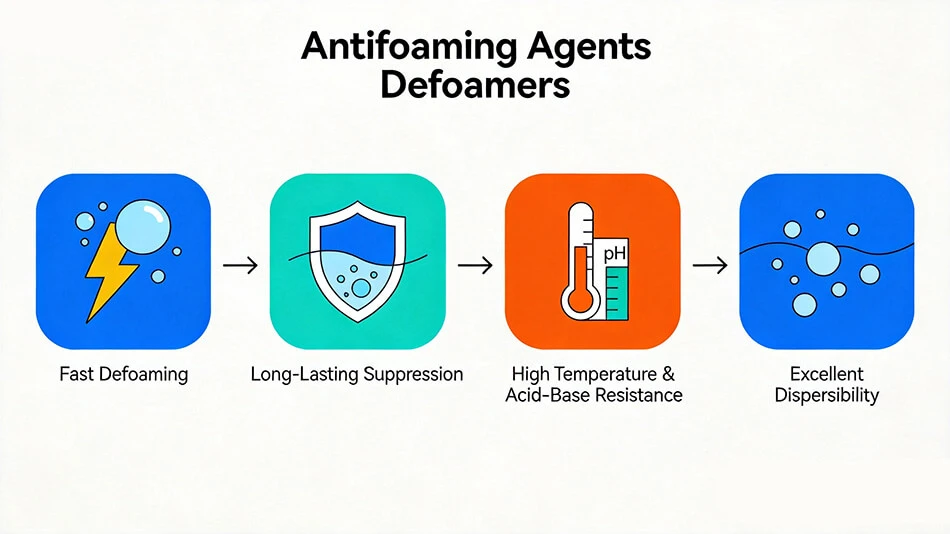
Advantages of polyether defoamers: long-lasting foam suppression, heat resistance for sterilization, excellent shear stability, no interference with microbial metabolism, easy separation with no residue—making them the preferred choice for most industrial fermentation processes.
Advantages of silicone-based defoamers: excellent defoaming performance, low dosage requirement, low surface tension, high chemical inertness, and wide applicability across various media (both aqueous and non-aqueous systems).
Advantages of polyether-modified organosilicon: combining the strengths of both—excellent dispersibility, superior defoaming and foam suppression, stable and non-toxic—representing the current development direction for high-performance defoamers.
5. Main Application Scenarios
1. Microbial fermentation industry
Polyether-based defoamers are widely used in high-value-added fermentation processes such as amino acid, antibiotic, and enzyme production, with dosages ranging from 0.02% to 0.08%. They can be added after high-temperature sterilization and before inoculation. In contrast, silicone-based defoamers tend to adsorb product impurities and are therefore only suitable for emergency foam control when sudden foaming occurs.
2. Industrial Water Treatment and Wastewater Treatment
Organosilicone defoamers are widely used in water treatment applications, including wastewater treatment and foam elimination in detergents. For harsh conditions such as high temperatures, strong acids or alkalis, and high shear forces, there are specialized shear-resistant defoamer products available. The recommended dosage is typically 0.1% to 0.3% of the total volume.
3. Coatings and Ink Industry
In the production and application of water-based coatings, defoamers must effectively address both large and fine bubbles. The new generation of silicone-oxygen defoamer achieves rapid bubble elimination at low addition levels while improving film density, with extremely low VOC content that meets environmental requirements.
4. Food Processing
In the production of fruit and vegetable beverages, soy products, sucrose, and other food items, defoamers are used to eliminate processing foam. Food-grade defoamers must comply with dosage regulations specified in the "Standard for the Use of Food Additives" (GB 2760-2014), and their use according to this standard is safe.
5. Textiles and Petrochemicals
Organosilicone defoamers can be used in non-aqueous foaming systems such as high-temperature and high-pressure dyeing in textiles, petroleum refining, and lubricant defoaming.
6. Selection Recommendations
When selecting a defoamer, the following factors should be considered comprehensively:
Process conditions: temperature, pH, shear force, and other factors determine the required tolerance.
Product standards: pharmaceutical grade requires high purity with no residue; food grade must comply with food safety standards.
Defoaming requirement: rapid bubble elimination or long-term foam suppression
Cost Budget: Achieving Economy While Meeting Performance Requirements
It is recommended to conduct small-scale trials to determine the optimal grade and dosage, achieving a balance between defoaming effectiveness, process stability, and production economy.