
 English
Problems Arising from the Application of Activated Carbon
Activated carbon indeed has many pitfalls in practical applications, with potential issues arising at every stage—from product quality and usage maintenance to safety.
Overall, there are mainly the following four categories:
📉 1. Product Quality and Selection Issues: Spent money but ended up with low-efficiency charcoal
This is the most common yet
Poor-quality products flood the market: some manufacturers cut corners on activation temperature and raw materials, and even mix carbonized material into activated carbon, significantly reducing the product's adsorption capacity. Companies may spend money but fail to achieve the expected treatment results.
The fallacy of "parameter obsession": Many people focus only on attractive data such as specific surface area and iodine adsorption value, but these do not fully reflect performance in real-world, complex environments. For example, when treating heavy metal ions, the chemical adsorption provided by surface functional groups (such as carboxyl groups) may be far more important than physical pore size. Relying solely on specifications can easily lead to being misled.
Inappropriate application scenarios: for example, in soil remediation, activated carbon not only adsorbs target pesticides but also faces competition from large amounts of natural organic matter (such as humic acid), causing "selective adsorption" to fail and resulting in actual adsorption performance significantly lower than ideal laboratory values.
⏳ 2. Usage and Maintenance Issues: No maintenance means using it in vain
Many problems arise during the usage phase, rendering activated carbon merely decorative.
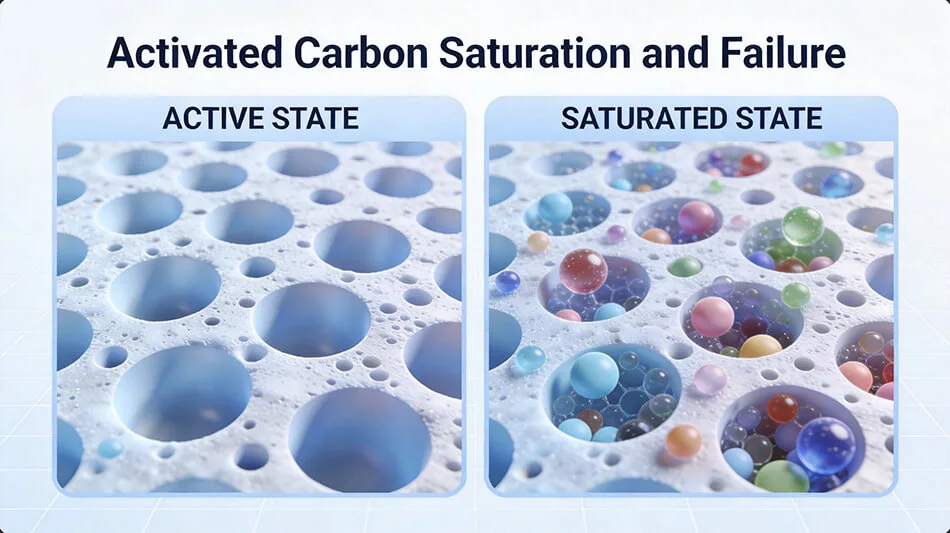
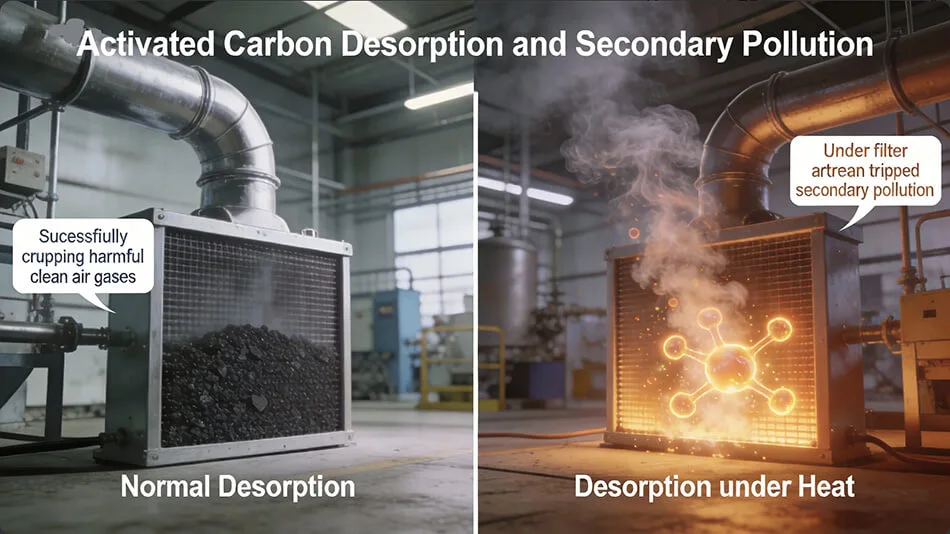
Adsorption saturation and secondary release risk: The adsorption capacity of activated carbon is limited and reversible. If not properly managed after reaching saturation, the adsorbed harmful gases (such as formaldehyde) may desorb and re-enter the environment, causing secondary pollution.
Inconsistent replacement cycles and poor management: Many companies are unaware of when to replace activated carbon, often leading to issues such as continued use of whitened, ineffective carbon or insufficient filling amounts. Although some air purification carbons are recommended to be replaced every 1–3 months and water purification carbons every 3–6 months, the precise industrial replacement cycle requires calculation based on exhaust gas concentration and adsorption capacity.
"Regeneration" of filters: Common household methods such as sun-drying are highly ineffective, only evaporating moisture and some volatile substances, without truly restoring adsorption capacity. True regeneration requires high-temperature steam or chemical processes, which, if improperly handled, may pose safety risks.
3. Safety and Compliance Risks: From Fines to Serious Hazards
This is also a common pitfall, especially in the industrial and medical fields.
Self-ignition and fire hazards: Activated carbon is inherently flammable. When adsorbing organic compounds such as VOCs, if the heat generated during adsorption cannot be dissipated promptly, there is a risk of self-ignition or even explosion.
Dust Inhalation Hazards: When handling or using powdered activated carbon, generated dust can irritate the respiratory tract, and prolonged inhalation may lead to diseases such as pneumoconiosis.
Side effects in medical use: When used as an antidote in emergency medical treatment, activated charcoal may cause constipation or intestinal blockage. If accidentally inhaled into the lungs, it can lead to severe pneumonia or even death.
Environmental compliance pressure: Enterprises are facing increasingly stringent environmental inspections and penalties due to improper use of activated carbon adsorption systems, such as unclear record-keeping and inadequate disposal of spent activated carbon as hazardous waste.
💡 4. Some Practical Tips
When shopping: Don't rely solely on marketing claims. Request test reports from the seller and pay attention to key indicators such as iodine adsorption value (higher iodine values generally indicate stronger adsorption capacity). You can also perform a simple test: add a small amount of activated carbon to clean water; if it produces abundant, fine, and long-lasting bubbles, it likely has good adsorption performance.
When in use: Always calculate the appropriate amount of activated carbon and replacement intervals based on parameters such as pollutant concentration and airflow volume, and maintain a proper maintenance log. Wear a mask during operation and keep away from sources of ignition.
In what specific scenario are you using activated carbon? For example, industrial exhaust gas treatment, household formaldehyde removal, or water purification? If it's convenient for you to let me know, I can share more targeted tips to help you avoid common pitfalls based on your situation.