 English

Distinction Between Coagulation and Flocculation
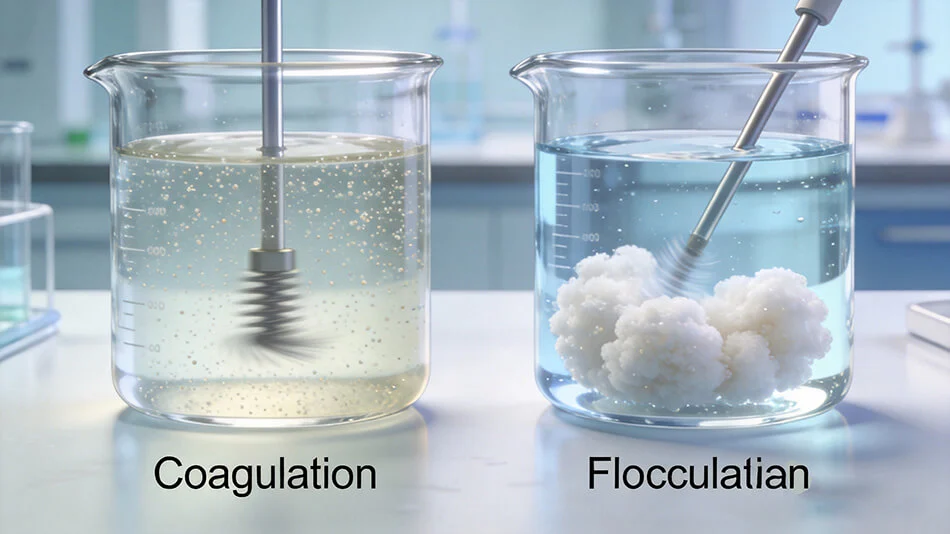
In water treatment, "coagulation" and "flocculation" are two concepts often confused. What is the difference between them? Why do PAC and PAM need to be used together? This article explains it all in simple, clear terms.
1. What is coagulation?
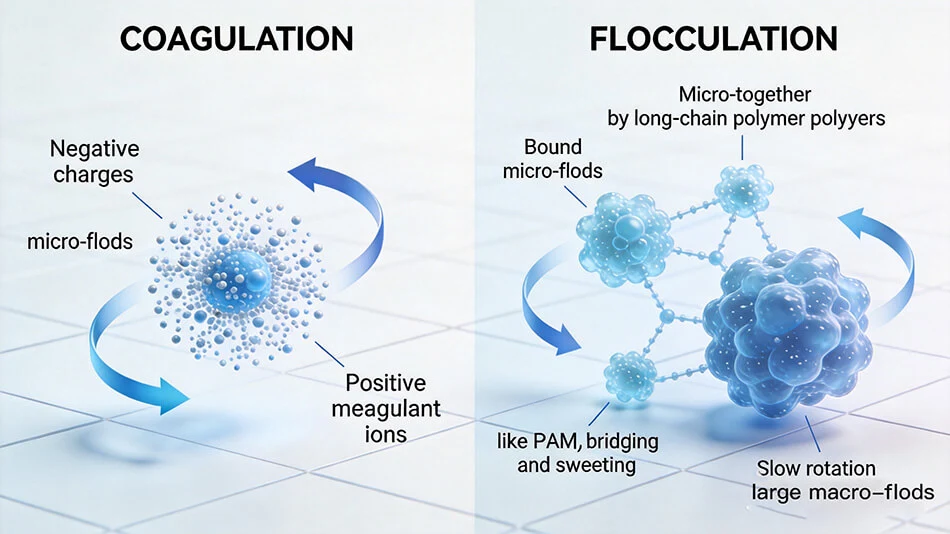
Coagulation refers to the process in which inorganic coagulants (such as PAC, polyferric sulfate, aluminum sulfate, etc.) are added to water, causing small suspended particles to lose stability and aggregate into tiny flocs through electrostatic neutralization.
Just like two magnets with opposite charges attract each other.
Key chemicals: polyaluminum chloride (PAC), polyferric sulfate (PFS), aluminum sulfate, etc.
2. What is flocculation?
Flocculation refers to the process following coagulation, in which an organic high-molecular flocculant (such as PAM) is added to water. Through adsorption and bridging mechanisms, it connects and entangles the already destabilized fine flocs into larger, denser aggregates, thereby accelerating sedimentation.
Like using a large net to gather all the scattered balls together.
Key chemicals: anionic PAM, cationic PAM, non-ionic PAM.