
 English

Calcium hypochlorite—a highly effective, broad-spectrum solid disinfectant
1. Product Overview
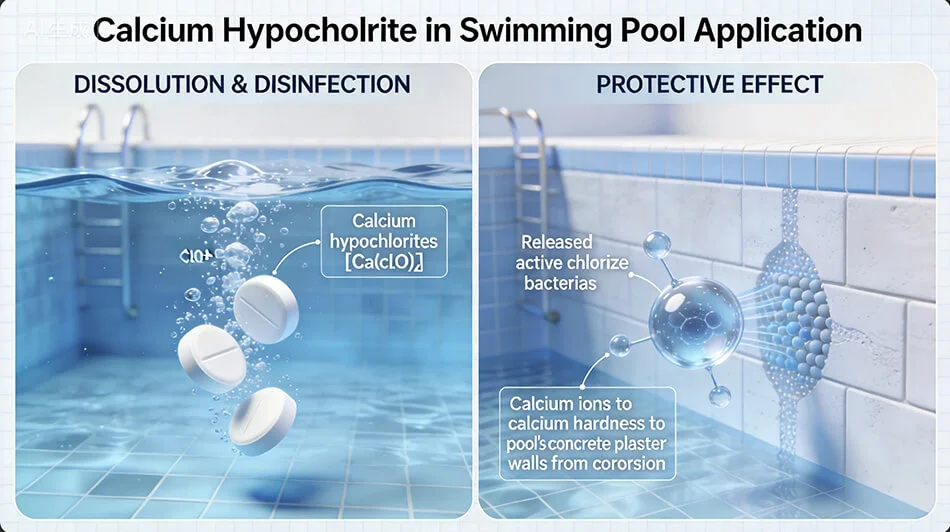
Calcium hypochlorite (chemical name: Calcium hypochlorite) is an inorganic compound with the molecular formula Ca(ClO)₂, a molecular weight of approximately 142.98, and CAS number 7778-54-3. It appears as a white powder or granular solid, has a distinct chlorine odor, a relative density of 2.35, and decomposes at 100°C. As a strong oxidizing agent, calcium hypochlorite releases active chlorine when dissolved in water, leveraging its powerful oxidizing properties to provide multiple functions including disinfection, sterilization, and bleaching.
II. Key Features
1. High effective chlorine content, strong germicidal power
Calcium hypochlorite has bleaching and disinfecting capabilities nearly equivalent to pure chlorine. Its aqueous solution is a yellowish-green, semi-transparent liquid, with effective chlorine content varying according to product specifications: ordinary bleaching powder typically contains about 35% effective chlorine, while high-efficiency bleaching powder (premium sun-dried powder) can contain 60%–75% effective chlorine.
2. Solid form, convenient for storage and transportation
Compared to liquid chlorine, calcium hypochlorite exists in solid form, making it safer and more convenient to store and transport, especially suitable for remote areas or locations lacking chlorine usage permits. It remains stable at room temperature for over 200 days without decomposition; after one year of storage, its available chlorine content decreases by only about 6.6%, and after three years, by approximately 14%, demonstrating greater stability than traditional bleaching powder.
3. Good solubility and flexible dosing
Calcium hypochlorite is highly soluble in water and can be quickly diluted to the desired concentration for disinfectant solution, making it suitable for various applications such as continuous dosing, shock dosing, and spraying.
4. Strong oxidizing power, acts rapidly
As a strong oxidizing agent, calcium hypochlorite can rapidly penetrate microbial cell walls, oxidize bacterial proteins, and denature them to inactivate the microbes, providing fast and broad-spectrum bactericidal action.
III. Sterilization Mechanism
The disinfecting and bactericidal effects of calcium hypochlorite are primarily achieved through the following pathways:
Step 1: Hydrolysis to form hypochlorous acid
When calcium hypochlorite dissolves in water, it first dissociates into hypochlorite ions (ClO⁻), and some of the hypochlorite ions react with water to form hypochlorous acid (HClO):
Ca(ClO)₂ → 2ClO⁻ + Ca²⁺
2ClO⁻ + H₂O → 2HClO + 2OH⁻
Step 2: Release New Ecological Oxygen
Hypochlorous acid is unstable and decomposes to form hydrochloric acid and nascent oxygen:
HClO → HCl + [O]
Step 3: Triple Sterilization Effect
The strong oxidizing property of new ecological oxygen causes protein oxidation and denaturation in microorganisms.
Hypochlorous acid directly acts on pathogen proteins, denaturing them and causing cell death.
Chlorine gas released from the decomposition of hypochlorous acid directly acts on bacterial proteins, causing protein denaturation.
In addition, hypochlorous acid molecules are small and uncharged, allowing them to penetrate into the interior of bacteria and viruses, where they react with proteins, nucleic acids, and enzymes through oxidation, resulting in thorough disinfection.
4. Product Specifications
Calcium hypochlorite exists in two important and common industrial product forms:
|
Product Type |
Available chlorine content |
Main Features |
Typical Applications |
|
Bleaching powder |
Approximately 35% |
Lower cost, moderate stability |
Pulp bleaching, drinking water disinfection, aquaculture disinfection |
|
Calcium hypochlorite (high-efficiency bleaching powder) |
60%–75% |
High content, excellent stability, low impurities |
Pool disinfection, drinking water advanced treatment, food industry |
Sodium-based bleaching powder offers more stable quality, higher effective chlorine content, and less residue after dissolution, making it suitable for applications with high water quality requirements.